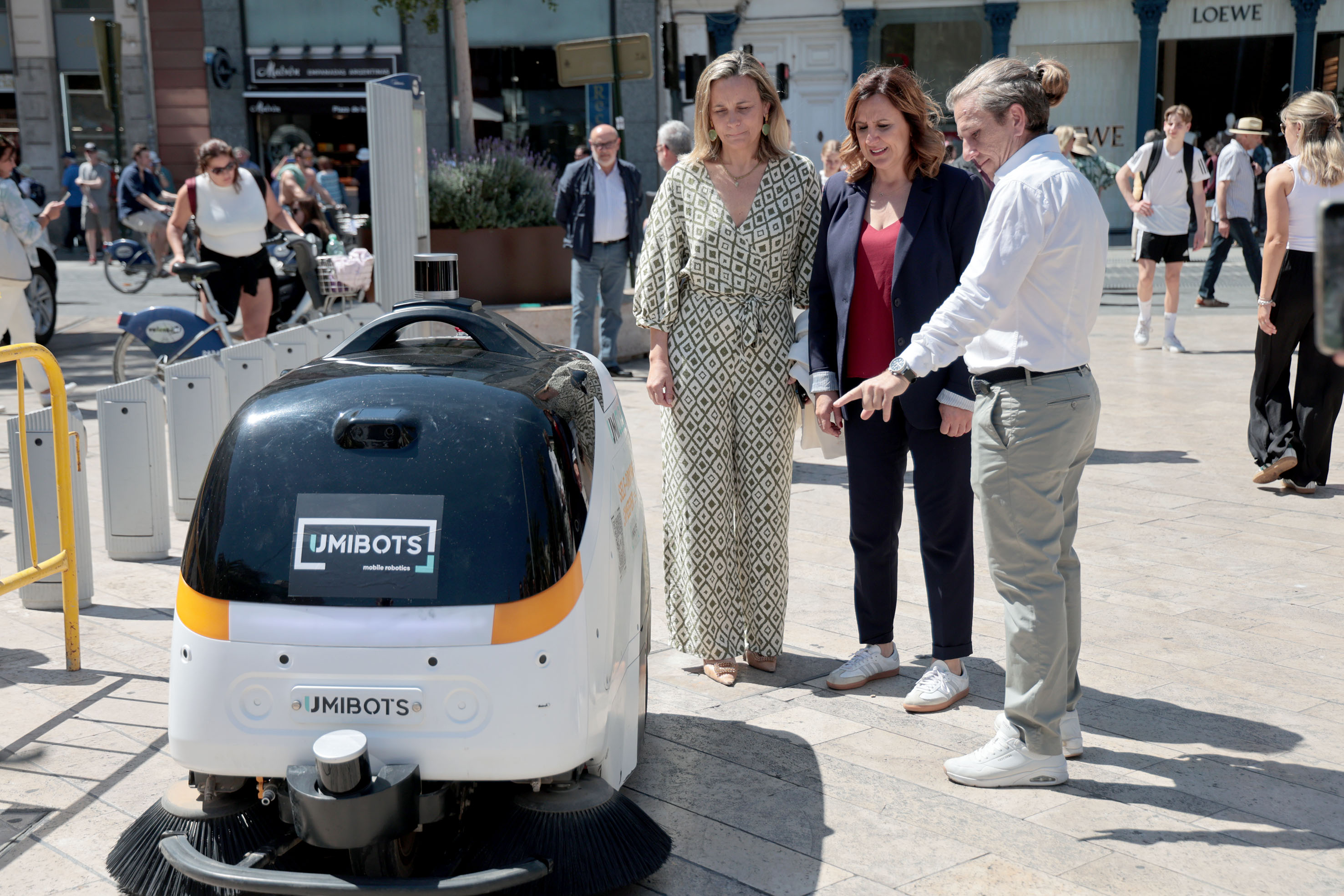
• Mayor María José Catalá attended the pilot demonstration of the autonomous and intelligent street-cleaning device on Monday.
• UmiClean is the first project to be tested in the city following the approval of València’s Urban Sandbox Ordinance.
• The initiative aims to make Valencia a place where future solutions are tested and integrated into everyday life, improving key areas such as sustainability, urban health, mobility and citizen participation, the Mayor said.
Valencia has launched its Urban Sandbox Ordinance with the deployment of UmiClean, an autonomous, electric street-cleaning robot that has begun operating as a pilot project on the city’s streets. Mayor María José Catalá attended the launch of the trial on Monday, accompanied by Paula Llobet, Councillor for Innovation, and representatives of the company behind the project.
The pilot will run over the coming weeks in Plaza de la Reina and around the Central Market, where the robot will operate in pedestrian areas carrying out urban cleaning tasks. The device is capable of cleaning up to 4,000 square metres per hour and can reach speeds of up to 5 km/h. It performs sweeping, vacuuming and washing operations, using artificial intelligence, cameras and sensors to navigate and carry out its work autonomously. The Mayor also highlighted that the robot can receive instructions through a digital platform, allowing it to respond in real time to requests or reports submitted by residents.
María José Catalá explained that the City Council’s objective in promoting initiatives such as this is “to make Valencia a place where future solutions are tested and integrated into the present, while improving key areas such as sustainability, urban health, mobility and citizen participation.”
UmiClean follows the successful pilot of UmiBeach, an autonomous beach-cleaning robot developed by the same company and tested last summer along the city’s coastline. Through these initiatives, Valencia continues to expand its Urban Sandbox programme. Since the ordinance came into force last September, 14 innovative proposals have been evaluated and 11 pilot projects have been authorised, “already transforming the relationship between citizens, technology and public space,” the Mayor noted.
“You bring the idea. We provide the city.”
The Urban Sandbox Ordinance is a public-private collaboration framework designed to promote economic development based on science, technology and innovation. It treats the entire city of Valencia and its urban assets—including public spaces, infrastructure and events—as a real-life testing environment where companies, startups and universities can trial innovative solutions, validate their products and services, and accelerate their path to market. As María José Catalá explained, “We facilitate collaboration between entrepreneurs, technology centres, universities and citizens in a real-world environment with the aim of driving economic and social development in our city.”
The guiding principle behind the initiative is “You bring the idea. We provide the city.” As the Mayor noted, “Innovation depends on ideas, investment and the ability to test them under real conditions. This is where the Valencia City Council becomes a trusted partner for the private sector, offering something that no investment alone can provide: a city and its resources as a relevant real-world testing environment.”
In just eight months of operation, the Valencia Urban Sandbox has already authorised 11 pilot projects, including autonomous cleaning robots for streets and beaches (UmiClean and UmiBeach), last-mile urban logistics using electric delivery robots (MercaBot), water management sensors to modernise the city’s irrigation network (HortaTech), artificial intelligence for monument recognition, biodiversity monitoring through bird sound analysis (BioSoundscape), and digital tools to encourage citizen participation. “We continue to expand the range of spaces available for experimentation,” the Mayor added. “We have incorporated 13 municipal libraries, the city’s hydraulic infrastructure within the francs, marjals i extremals system, and more locations will be added in the near future.”
Catalá also stressed that “Valencia has become a pioneering city in providing urban spaces and infrastructure that enable innovative projects to succeed,” noting that “other cities such as Madrid, Barcelona and Zaragoza are now following our example.”
This model strengthens Valencia’s ability to attract scientific, technological and economic investment while retaining local talent and innovative companies that would otherwise need to relocate to develop and test their solutions. At the same time, the Urban Sandbox contributes to higher-quality public services and more efficient management of municipal resources, delivering tangible benefits for citizens.