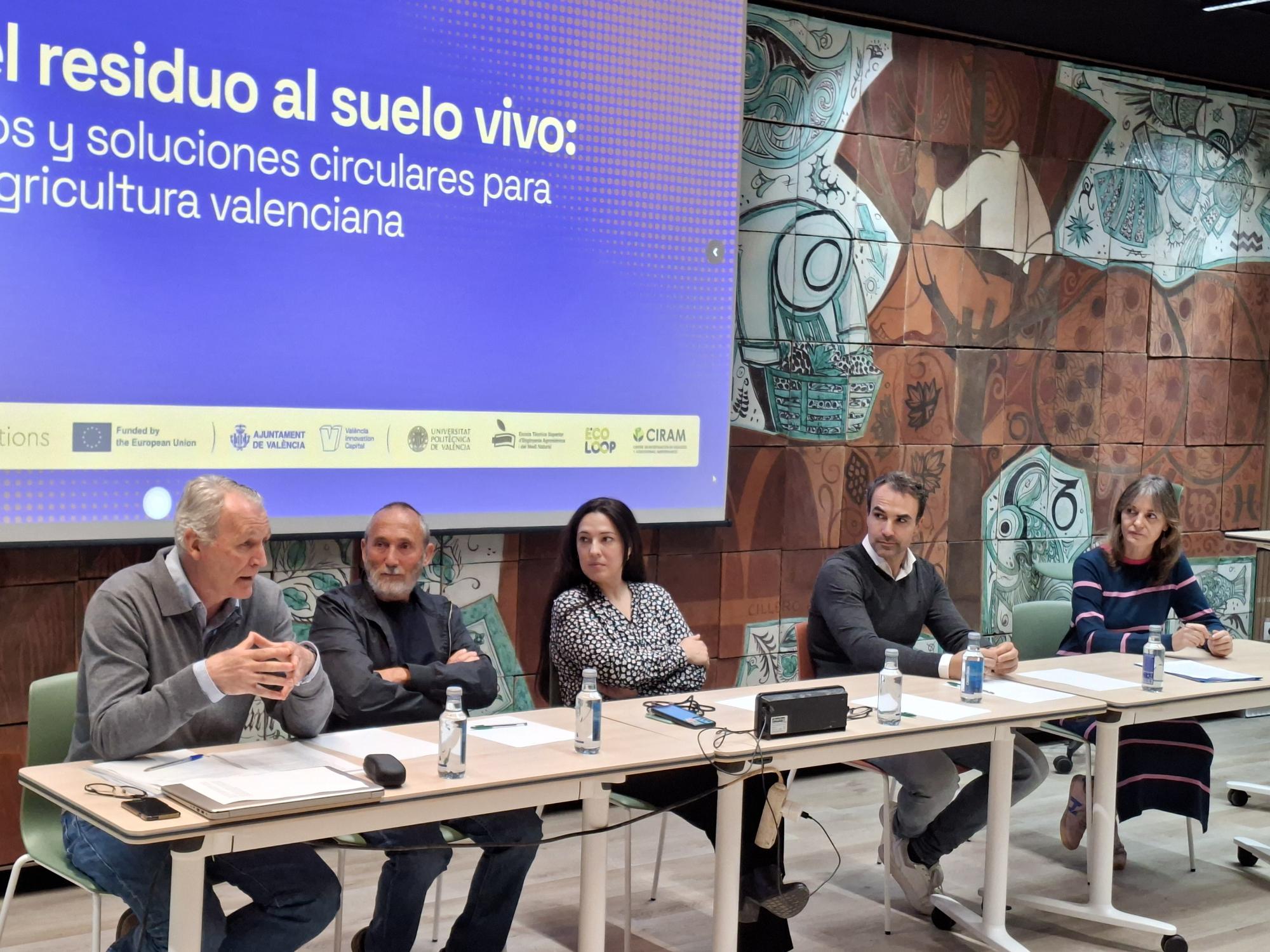
- This European initiative, in which València Innovation Capital has participated and which will conclude in a few weeks, has fostered open innovation spaces to connect farmers, businesses, research centers, and government agencies around soil health and resource circularity.
- The project has focused on the recovery of biological waste to develop new products designed to improve soil quality and recover nutrients.
The City of Valencia, through Valencia Innovation Capital, has highlighted the results and legacy of the European BioSoilutions project, which concludes at the end of this month, and which has focused over the past four years on converting underutilized biological waste streams into safe and effective products to improve soil health. The initiative, funded by the Horizon Europe program as part of the European Soil Mission, has received a contribution of nearly 3 million euros from the European Union and is coordinated from Valencia by SAV Agricultores de la Vega de Valencia and Valencia Innovation Capital.
A few days ago, the conference “Living Soil: Circular Challenges and Solutions” was held in Valencia to conclude the project. The event brought together organizations, professionals, companies, farmers, researchers, and institutional representatives to address soil health, nutrient circularity, and agricultural sustainability. The event also served as an opportunity to share the lessons learned during the project.
Paula Llobet, Councilwoman for Innovation, Tourism, and Investment Attraction, noted that Valencia’s participation in BioSoilutions “reinforces our strategy of putting innovation to work to address real challenges. “We’re talking about recovering nutrients, making use of resources that until now were considered waste, and developing solutions that can help regenerate our soils and increase the resilience of our agri-food system, making our agriculture more sustainable and circular.”
Four pathways to resource recovery
BioSoilutions addresses a Europe-wide challenge: between 60% and 70% of the soil in the European Union shows some degree of degradation. To address this problem, the project has adopted a circular economy approach based on four pathways for the recovery of biological waste: blood hydrolysate, frass, N-struvite, and K-struvite. Its goal has been to convert these waste streams into advanced soil products and promote the recovery of nutrients and organic matter, while reducing the need for landfilling and incineration.
The project is also being carried out as part of the European initiative “A Soil Deal for Europe,” which aims to promote healthy and resilient soils through research, innovation, and experimentation in real-world settings.
Open Innovation from Valencia
One of Valencia Innovation Capital’s main contributions to the project has been the creation and promotion of open innovation spaces involving farmers, landowners, agricultural cooperatives and associations, companies and startups, fertilizer producers, government agencies, universities, research centers, students, and other stakeholders in the sector.
The European project has established Living Labs in Flanders, Valencia, and Murcia to directly involve industry stakeholders in the development of solutions, verify that they meet real-world needs, and facilitate their future market launch.
For Paula Llobet, “one of the key lessons we’ve learned from BioSoilutions is that innovation isn’t just about developing new technology. We need to connect scientific knowledge with farmers, companies, entrepreneurs, and government agencies; test solutions in real-world contexts; and build communities capable of sustaining that innovation over time.”
In this regard, the experience gained during the project has enabled València Innovation Capital to strengthen the city’s Agrotech network by bringing in new farmers, cooperatives, companies, government agencies, researchers, and students involved in the transition toward more sustainable agricultural systems.
A legacy that will continue beyond the project
Participation in BioSoilutions has also helped consolidate new avenues of collaboration that will continue. Notable among these are Valencia’s participation in the Mediterranean GREENNOMED network and the establishment, in partnership with CETENMA, of its regional office in Valencia.
The insights and challenges identified during the project also serve as the foundation for the fourth edition of the AgroLab accelerator, which focuses specifically on soil health, with the goal of aligning innovative business solutions with the real needs of the agricultural sector. In addition, collaboration with the expert team in Soils/Edaphology at ETSEAMN (Polytechnic University of Valencia) has been strengthened, with the goal of generating new opportunities for applied research, knowledge transfer, and projects related to regenerative agriculture and sustainable soil management.
“BioSoilutions is coming to an end, but the work continues. The project leaves us with a stronger network, new partnerships, and knowledge that we are already applying to new programs and projects. We want Valencia to remain a place where farmers, scientists, businesses, and government work together to test and scale solutions that contribute to more competitive and sustainable agriculture,” said Paula Llobet.