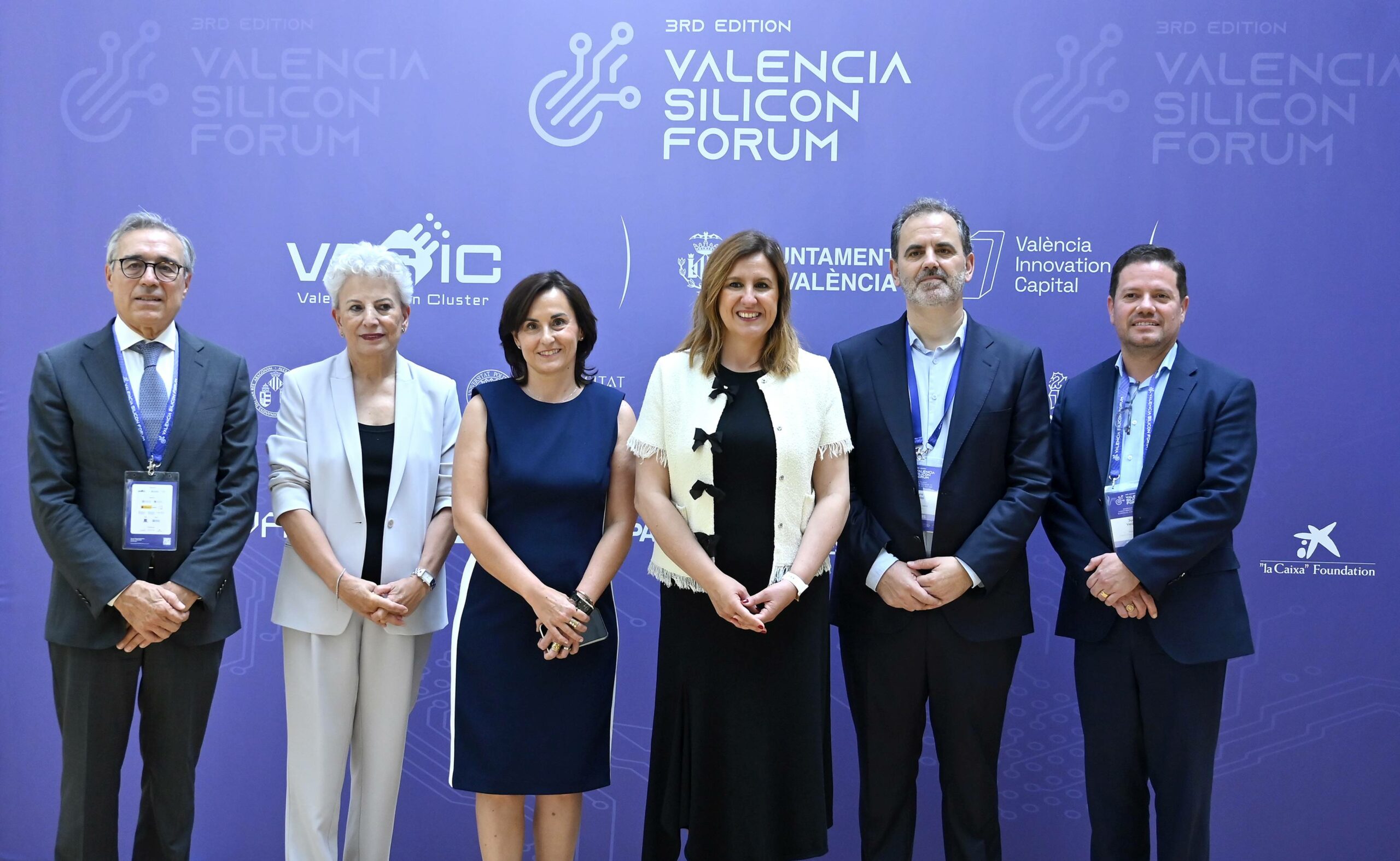
- María José Catalá: “Valencia is a strategic region in Europe in the field of microchips; and it is so because we have talent and leadership.”
- The mayor introduces the head of the European Commission’s Semiconductors and Photonics Unit during the third edition of the València Silicon Forum
- The European Union aims to mobilize 120,000 million euros in public-private investment to revitalize the semiconductor industry over the next decade
The European Commission (EC) has chosen the city of Valencia as the venue for the first public presentation of the proposed new European Chips Act 2.0, the future legislation that will define the legal, industrial, and financial framework for the semiconductor sector across the 27 member states of the European Union (EU) over the next decade. Formally presented by the EC in June 2026, this law represents an evolution from the first version of 2023, in that it acknowledges that building factories is not enough and radically refocuses on technological sovereignty in the context of Artificial Intelligence (AI) and direct market stimulation. To this end, the EU aims to mobilize 120,000 millones de euros in public-private investment by 2035.
The third edition of the València Silicon Forum, taking place this Thursday and Friday at the CaixaForum in the City of Arts and Sciences, hosted the formal presentation of the European Chips Act 2.0, before an audience of more than 400 attendees and over 70 leading international speakers in the fields of microchips, technological innovation, and industrial sovereignty. This marks a significant milestone for the Valencian semiconductor ecosystem.
The mayor of Valencia, María José Catalá, introduced Arian Zwegers, head of the European Commission’s Semiconductors and Photonics Unit, on Thursday in what marked the first official public presentation of the legislative text, just one day after the proposal was formally presented in Brussels. The choice of Valencia, as the mayor emphasized, places the city and its technology ecosystem at the center of the European debate on the future of the semiconductor industry.
Strategic Territory
“Valencia is already a strategic region in Europe in the field of microchips. And it is so because we have two key strengths: talent and leadership. The city and its metropolitan area are home to 50% of the country’s professionals working in microelectronics and nearly 60% of the workforce specializing in photonics,” said María José Catalá on the opening day. “These figures are simply a reflection of years of work, research, and training, and the result of a very powerful and well-established ecosystem,” she added.
The European Chips Act 2.0 is the regulatory framework that will establish the legal basis and financial instruments designed to strengthen the European Union’s capacity for design, manufacturing, research, and attracting investment in microelectronics. The new legislation is set to play a decisive role in Europe’s technological competitiveness and strategic autonomy in a sector considered critical to the continent’s economy and security.
The selection of Valencia as the venue for this first public presentation also recognizes the leading role that the Valencian ecosystem has played in drafting the future legislation, as highlighted by Mayte Bacete, president of València Silicon Cluster, the organization hosting the event alongside the Valencia City Council as part of the municipal strategy “València Innovation Capital.”
València Innovation Capital
The mayor highlighted the City Council’s role “as a driving force in local government” through València Innovation Capital and cited two examples of municipal initiatives: the launch of the first semiconductor talent accelerator in collaboration with the Polytechnic University of Valencia (UPV) and an outreach initiative to raise awareness of the semiconductor industry among the general public in Valencia, particularly among young people. “We want them to know that one of the most important industries of the 21st century is being built in their city, so that more students will choose this path. And we want all citizens to know—and understand—why what we do here matters,” the mayor emphasized.
A highlight of the third edition of the Valencia Silicon Forum is the participation of Maria Marced, former president of TSMC Europe and chair of the Commission’s Industry Advisory Group
European Union, as well as Carlos G. Triviño, secretary general of the Valencia Silicon Cluster and technical secretary of this EU advisory body. The Industry Advisory Group comprises the 16 leading semiconductor companies in the European Union and has been one of the main forums for industrial advice during the process of designing the new European chip policy.
In addition to the presentation of the European Chips Act 2.0, the 3rd Valencia Silicon Forum brings together prominent international leaders from the sector. Among them is Juan Velásquez, global director of the Strategic Office at Purdue University (Indiana, U.S.), currently considered one of the world’s leading academic institutions in the field of semiconductors.
Also participating will be Jean-Luc Di Paola-Galloni, executive vice president of the Valeo Group and industrial chair of the Chips Joint Undertaking (Chips JU), the European agency responsible for implementing the EU’s semiconductor policy and managing the main investment and innovation programs in this field.
With the holding of this third edition, the València Silicon Forum consolidates its position as one of Europe’s leading events specializing in microelectronics, semiconductors, and strategic technologies, reinforcing the city of València’s role as a key hub for the international technology industry and for the development of future European industrial policy.