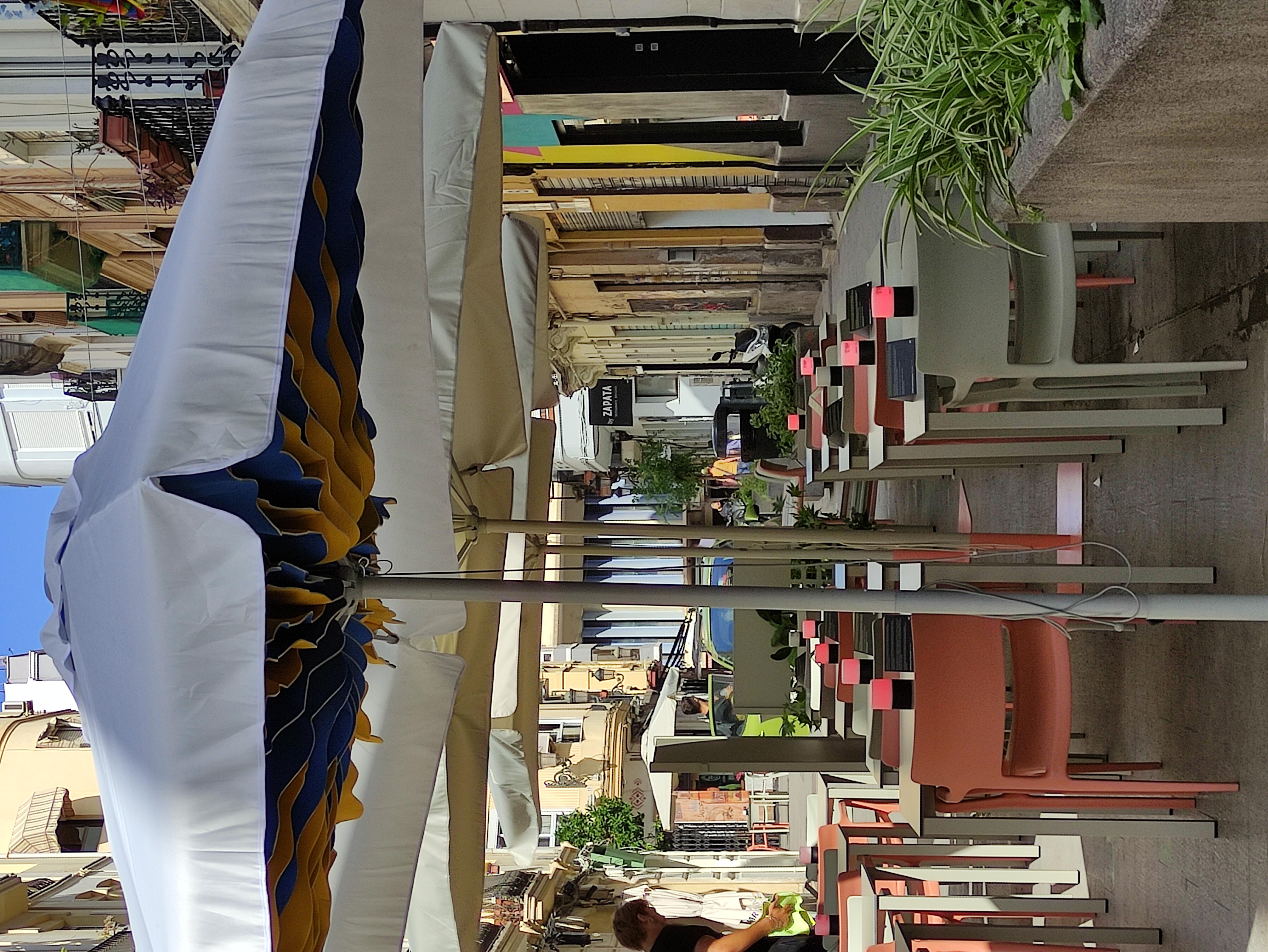
The initiative, named “Ecoterrazas Sostenibles,” is sponsored by the departments of Innovation, Tourism, and Climate Action, in collaboration with the Russafa Al Balansí Hospitality Association, and is taking place this year at restaurants and bars along both sections of Cura Femenía Street.
The terraces of these establishments feature a uniform design made with sustainable materials, with the goal of reducing noise levels generated by recreational activities in the area; in addition, an awareness campaign has been launched among patrons.
The Valencia City Council, as part of its “València Innovation Capital” innovation strategy, has launched—through the departments of Innovation, Tourism, and Climate Action—a pilot project aimed at creating a standardized and environmentally friendly model for outdoor dining areas. The initiative, carried out in collaboration with the Russafa Al Balansí Hospitality Association, will take place this year in the Russafa neighborhood, specifically along the two sections of Cura Femenía Street.
The objectives of this pilot project, known as ECOTerrazas Sostenibles, are varied. On the one hand, it aims to reduce noise levels generated by recreational activities in the area by incorporating sustainability criteria. To that end, sustainable furniture and materials have been installed on the terraces of the establishments—9 in total—along with sound-absorbing discs and umbrellas.
This pilot project aims to test a terrace design that could subsequently become the official model to which all other establishments in the city must conform, while always meeting criteria for sustainability and resilience to weather conditions and with the goal of facilitating the neighborhood’s right to relaxation.
Paula Llobet, the Councilor for Innovation and Tourism for the City of Valencia, stated during the presentation in Russafa that “this pilot project is groundbreaking. We chose the Russafa neighborhood because of its unique character. It’s a perfect testing ground for this initiative, which seeks a new model for urban outdoor seating areas—ones that are more sustainable and people-friendly—that can also be adapted to other parts of the city or even serve as a model for other cities. This pilot project also brings us closer to similar examples we see in other European cities.”
For his part, Carlos Mundina, the councilor for Climate Action, emphasized that the project “is innovative and allows us to test a solution aimed at ensuring that Valencia has an urban space that is respectful of both the environment and people.”
Awareness-raising and monitoring
The pilot program also includes an original awareness campaign designed by the creative studio GRANISSAT and aimed at both customers of the neighborhood’s businesses and the general public. To this end, resources such as existing digital street furniture in the neighborhood and throughout the city are being used to provide information about the pilot project, calling on residents to help reduce noise and promote harmonious coexistence with the neighborhood, as well as other materials such as informational stands for tabletops and posters.
The pilot program also adds new features to the existing sound level meters in the area; in particular, lights have been installed on the terrace tables to alert customers and business owners when noise levels reach higher thresholds.
In addition, the initiative includes training and awareness-raising sessions, in collaboration with Controla Club and the Valencia Local Police, and information regarding the establishments’ permits and licenses has been digitized via QR codes, which have been prominently displayed at the establishments.
Public-Private Partnership
The pilot project began with the preparation of an assessment that involved key stakeholders (neighbors, local businesses, police, city government, etc.), defined the pilot’s characteristics, and proceeded with the design—in collaboration with the Valencian Community Design Foundation—and its adaptation for the trial.
Public-private collaboration has been essential in implementing technical solutions on the participating terraces.
All of the companies that have collaborated are based in the Valencian Community: the design of the standardized terrace model—conceived with sustainability and climate change adaptation in mind—was developed by ODOS DESIGN under the guidance of València Innovation Capital; RIPAY was responsible for the furniture, which is made from recycled plastic, and the umbrellas are constructed with three layers to improve thermal comfort (this type of fabric and its three layers help reduce the temperature); the sound-absorbing panels were produced by SILENZIA and were specifically designed for this pilot project using a fabric that absorbs sound waves (its effectiveness has been proven in indoor settings), as were the Absorbrella sunshades, which feature a wool fabric to improve acoustic comfort outdoors; finally, the lamps incorporate a smart alert system conceived by València Innovation Capital and created by the companies DAMAL REDES and LORIOT; they are connected via Wi-Fi to acoustic sensors so that when noise levels rise, the lighting changes color (shifting from warm light to red).
Following the pilot program, which will conclude at the end of November, we will proceed with data collection, analysis, and evaluation of the project, followed by the drafting of a report and the publication of the findings.