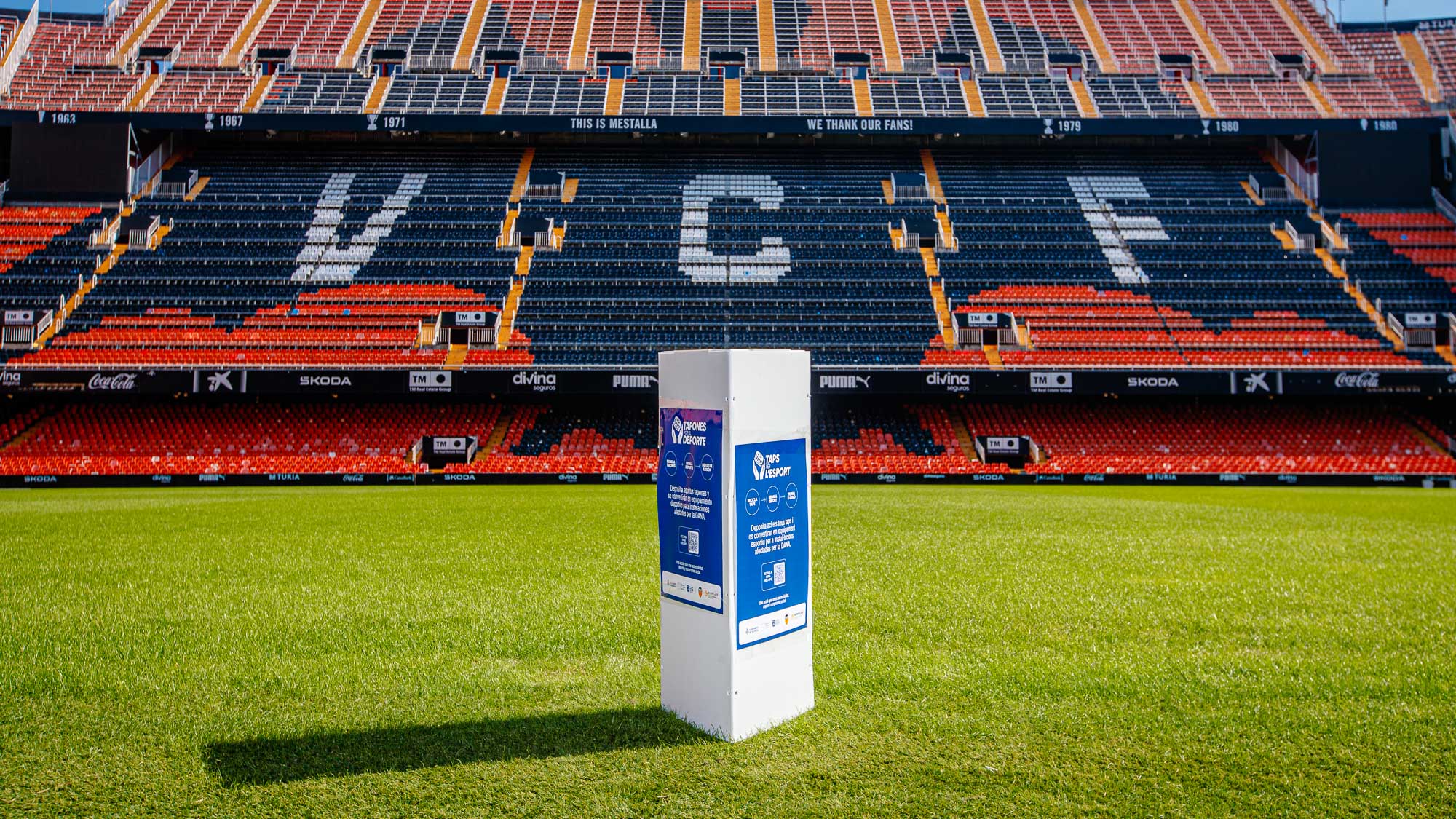
- València Innovation Capital is leading this initiative, together with Valencia CF, the Plastics Technology Institute (AIMPLAS), and the Municipal Sports Foundation
- The goal of this pilot project is to transform bottle caps into furniture and sports equipment that will be donated to municipal sports facilities affected by the cold snap
- Paula Llobet, the councilor for Innovation, emphasized that “with ‘Bottle Caps for Sports,’ we’re integrating citizen participation and social commitment into resource management.”
Paula Llobet, the Councilor for Innovation at the Valencia City Council, noted that “with this initiative, we are bringing together three fundamental pillars of the Valencia City Council’s strategy: innovation, sustainability, and solidarity, with the aim of establishing a more responsible urban model that transforms waste into opportunities—which, in this case, will be turned into furniture and materials for municipal sports facilities affected by the storm.”
With these words, Llobet unveiled the pioneering project “Tapones por el deporte” on Thursday, an innovative initiative that promotes the circular economy by repurposing waste generated in the sports sector.
The event was attended by representatives from the four organizations involved in the project: València Innovation Capital, which is responsible for the overall coordination of this initiative; Valencia CF; the Plastics Technology Institute (AIMPLAS); and the Municipal Sports Foundation.
This pilot project, which will run for a year and a half—until the end of 2026—focuses on collecting bottle caps at Camp de Mestalla to transform them into new products useful for sports and recreation, such as seats and nets for ping-pong tables. These items will be used to renovate municipal sports facilities damaged by the storm in the districts of El Forn d’Alcedo, Castellar-l’Oliveral, and La Torre.
In addition, this project pursues three main goals: to explore the potential of the circular economy in large-scale sporting events, demonstrating how plastic waste can be transformed into value-added products through recycling; raising public awareness about sustainability and responsible waste management; and generating a positive social impact by allocating the profits toward improving municipal sports facilities in areas affected by the flood.
Commitment to Sustainability and Innovation
During the presentation, Llobet emphasized that “with ‘Tapones por el deporte,’ we are integrating citizen participation and social commitment into resource management. In this way, Valencia is moving toward a more responsible model of city governance, where sports become a public-private partnership in action.”
For his part, Valencia CF’s Director of Infrastructure and Operations, Christian Schneider, who expressed the club’s satisfaction at being part of this initiative, stated that “we are making our facilities—such as Camp de Mestalla and the Ciudad Deportiva—available to collect bottle caps, which will then be recycled and used as sports equipment for the areas affected by the flood; therefore, we want to encourage all fans to get involved because they are the essential part of this project that brings together sports, sustainability, and social commitment—and without them, it wouldn’t move forward.”
Likewise, Adrián Morales, AIMPLAS’s lead researcher in Mechanical Recycling, has noted that thanks to innovation in plastics recycling, “we’re able to turn waste—such as a bottle cap—into a high-value raw material, ready to be transformed into products that improve our cities, in other words, we give it a second life. Our role is to provide innovative solutions that generate value for industry, the environment, and society.”
Awareness and Civic Engagement Campaign
The project includes a communication and awareness campaign aimed, on the one hand, at the fans who attend Mestalla, with the goal of informing them and encouraging them to collect bottle caps during games; and, on the other hand, at the general public, with the aim of publicizing the project’s progress throughout all its stages.
