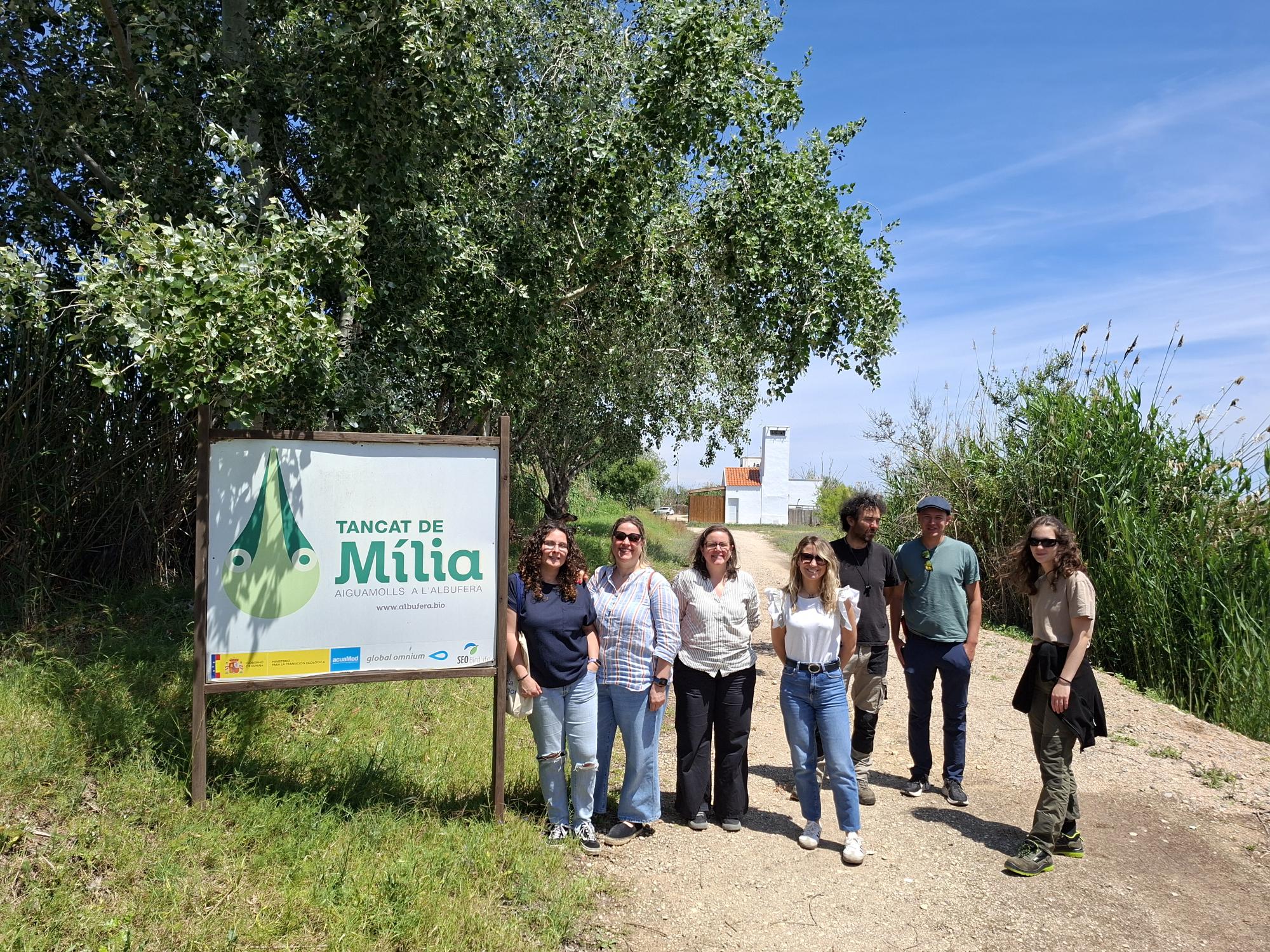
A European technical delegation, made up of the project’s modeling specialists, visited the urban and peri-urban pilot sites, located in the city and in l’Albufera.
Paula Llobet, the councilor for Innovation, emphasizes that Valencia “is establishing itself as a European urban laboratory for developing real solutions to climate and environmental challenges.”
Valencia, May 18, 2026.—Valencia today hosted a technical visit from the modeling and simulation team of the European Watergrid project, of which our city is a part. These technical staff members, from BOKU University (Austria)—also a project partner—gained firsthand insight into the main demonstration projects in Valencia that are part of this European initiative for water innovation and urban resilience.
The Watergrid project, funded by the Horizon Europe program, brings together 22 organizations from 13 European countries with the goal of developing a Smart Water Grid (Smart Water Grid) based on digital solutions, advanced monitoring, and nature-based solutions (NBS) to improve resilience to climate change and water scarcity. Among the Valencian partners are València Innovation Capital, the City of Valencia, and Global Omnium, along with other organizations involved in environmental innovation from across Europe.
Visit to the Albufera
During the visit, the delegation toured the established peri-urban pilot project at Tancat de Milia, a leading example of the application of nature-based solutions to improve water quality and biodiversity in the Albufera area. This artificial wetland treats reclaimed water and eutrophicated water from the lake using natural processes, thereby also promoting the environmental recovery of the natural park.
The visit continued at the new peri-urban site associated with the project, which is centered around rice-growing fields, where new agricultural strategies and nature-based solutions will be evaluated to increase water resilience and improve sustainable water management in the l’Albufera area.
Green Infrastructure
The delegation also visited the Benicalap neighborhood, specifically to the Bosquete urban space, a project previously developed as part of the now-completed European GrowGreen project, which currently serves as an example of urban green infrastructure and climate adaptation based on natural solutions—similar to what will be implemented in another of Watergrid’s pilot projects. This involves the installation of a micro-SUDS (Sustainable Urban Drainage System) applied to tree pits, the final location of which is currently being studied. During the visit, technical staff were able to learn about the strategies implemented for sustainable stormwater management, urban renaturalization, and improving the climate comfort of the surrounding environment.
The project partners also met at Las Naves, where they jointly reviewed the results obtained so far and discussed technical issues related to the modeling and evaluation of the pilot projects in Valencia.
Paula Llobet, the councilor for Innovation, emphasized that “Watergrid perfectly embodies the strategy of València Innovation Capital to transform the city into an urban innovation laboratory capable of developing real solutions to major climate and environmental challenges. The Valencian pilot projects within this initiative are strategically important for demonstrating how innovation applied to smart water management can have a positive impact on the region, biodiversity, and urban sustainability.”
Llobet also noted that “collaboration among European institutions, research centers, universities, and companies helps accelerate the implementation of nature-based technologies and solutions that improve citizens’ quality of life and strengthen Valencia’s resilience to climate change.”
For its part, Global Omniun has emphasized that the priority of the Watergrid project is to demonstrate the real effectiveness of nature-based solutions in protecting ecosystems. The company is focusing its efforts on validating how these natural systems, when integrated into water management, not only improve water quality but also serve as essential tools for maintaining and enhancing biodiversity in the Albufera Natural Park, ensuring a resilient and balanced environment.