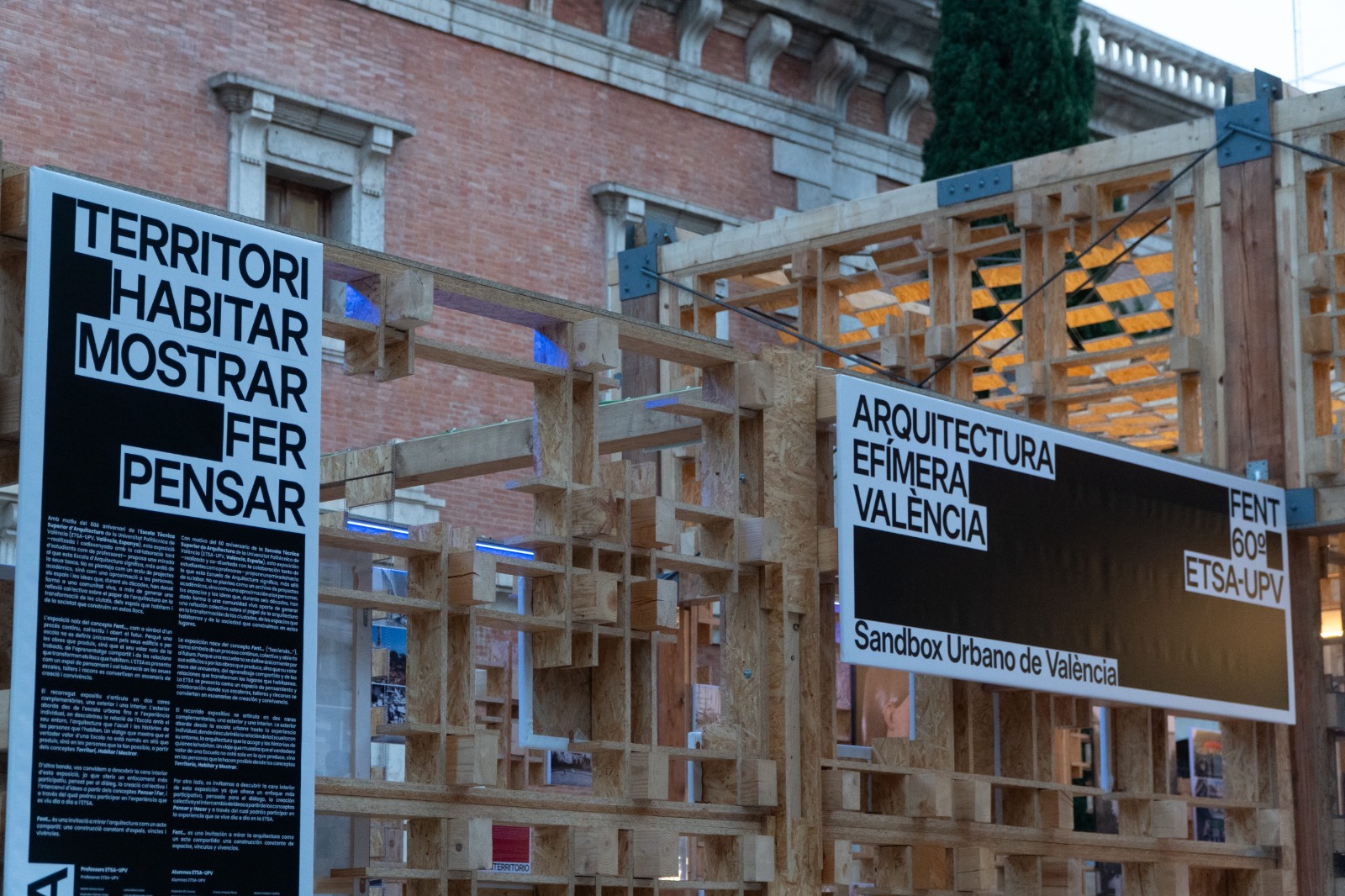
The initiative is part of the celebration of ETSA-UPV’s 60th anniversary and turns this milestone into an opportunity to test new architectural and urban solutions in real-world conditions in Valencia
The pilot project “The City as a Test Bed” uses the temporary installation to evaluate ideas related to urban comfort, sustainability, and the revitalization of public space
The City of Valencia, through the Urban Sandbox, has facilitated real-world experimentation for the project “La ciudad a ensayo: ephemeral architectures to innovate the urban future. 60 ANYS FENT,” promoted by the Polytechnic University of Valencia (UPV) as one of the main knowledge-transfer initiatives linked to the 60th anniversary of its Higher Technical School of Architecture (ETSA-UPV).
The initiative proposes the creation of a temporary, demountable, and reversible architectural installation in public space, conceived as an experimental urban prototype in which to test innovative solutions related to the revitalization of public space and the transformative potential of architecture. The structure combines its function as temporary urban infrastructure with cultural, educational, and applied research activities.
Paula Llobet, the councilor for Innovation, emphasized that the Urban Sandbox “allows us to open the city up to responsible experimentation and turn public space into a real-world learning environment. “With initiatives like ‘La ciudad a ensayo,’ we want to test, measure, and evaluate new solutions before considering their possible implementation in other parts of Valencia.” Llobet also noted that this initiative “reflects the innovation model of Valencia Innovation Capital: innovation connected to the city, to universities, and to citizens, capable of generating useful knowledge to improve public policies and the quality of our urban spaces.”
An urban laboratory open to the public
The facility is designed as a lightweight, open, modular, and sustainable structure that will be able to host exhibitions, conferences, workshops, educational activities, and other events related to architecture, urban design, and city planning. In addition, the project actively involves faculty, staff, and students from ETSA-UPV in various phases, from co-design and construction to the development of activities and the evaluation of results.
The project allows for the evaluation of the environmental, social, and functional performance of public spaces under real-world conditions. Among other aspects, the study will analyze microclimatic comfort, patterns of use and public engagement, passive strategies and nature-based solutions, the technical and logistical feasibility of this type of facility, user perceptions, and CO₂ equivalent emissions associated with the project’s life cycle.
The pilot project also includes a comparative assessment before and after the initiative to identify the conditions for success, the limitations, and the potential for replicating this type of temporary solution in other areas of Valencia.
“The value of the Sandbox lies precisely in the ability to move from an idea to a real-world test in a controlled and measurable way. Valencia thus becomes a space where the university, the government, and citizens can learn together and generate evidence to determine which solutions work and can add value to the city,” the councilwoman added.
The location will allow for the testing of a contemporary and reversible architectural intervention in a high-traffic urban setting with significant heritage value. The project is designed to avoid permanent damage to the pavement, subsoil, or protected elements, and provides for the restoration of the space once the experiment is complete.
The inclusion of “La ciudad a ensayo” in Valencia’s Urban Sandbox allows the solution to be tested in the very environment for which it was designed, generating data on its results before evaluating a potential replication on a larger scale. As a way of giving back to the city, the project plans to open its activities to residents and visitors and to promote municipal initiatives related to design, architecture, and urban planning. In this way, the project strengthens collaboration between the university and the city and uses the Urban Sandbox as a tool to generate knowledge, institutional learning, and evidence that can contribute to the improvement of public services and future urban interventions in Valencia.