The Flash Park pilot project is evaluating a real-time parking space monitoring system to improve occupancy and optimise parking management.
The data collected through sensors helps reduce congestion while supporting more efficient and sustainable management of urban space.
“Valencia continues to strengthen its position as a benchmark for urban innovation through a new pilot project promoted by the Urban Sandbox,” said Paula Llobet, Councillor for Innovation. “On this occasion, Flash Park is testing a technological solution in the surface car park at the Valencia Conference Centre that provides real-time information on parking space occupancy. The system also enables more efficient parking management through the use of smart sensors and Bluetooth technology.”
This pilot project makes it possible to validate the performance of the Flash Park Point v1 devices in a real-world environment, as well as assess their reliability and accuracy under everyday operating conditions. It also enables an evaluation of their ability to support more efficient parking management. In addition, the project examines the impact of this technology on reducing traffic congestion, improving the user experience, and generating data to support better urban mobility planning.
Paula Llobet, Councillor for Innovation, said: “The Urban Sandbox transforms Valencia into an open innovation laboratory where companies can validate technological solutions with a real impact on the city before they are potentially deployed. We are committed to innovations that improve public services and help build a smarter, more efficient and more sustainable city.”
She added: “This project demonstrates how technology can help us optimise the use of a resource as limited as parking space. In addition to improving mobility and reducing unnecessary journeys,
the information gathered will enable data-driven decision-making to continue advancing towards more efficient urban management.”
Seven smart devices
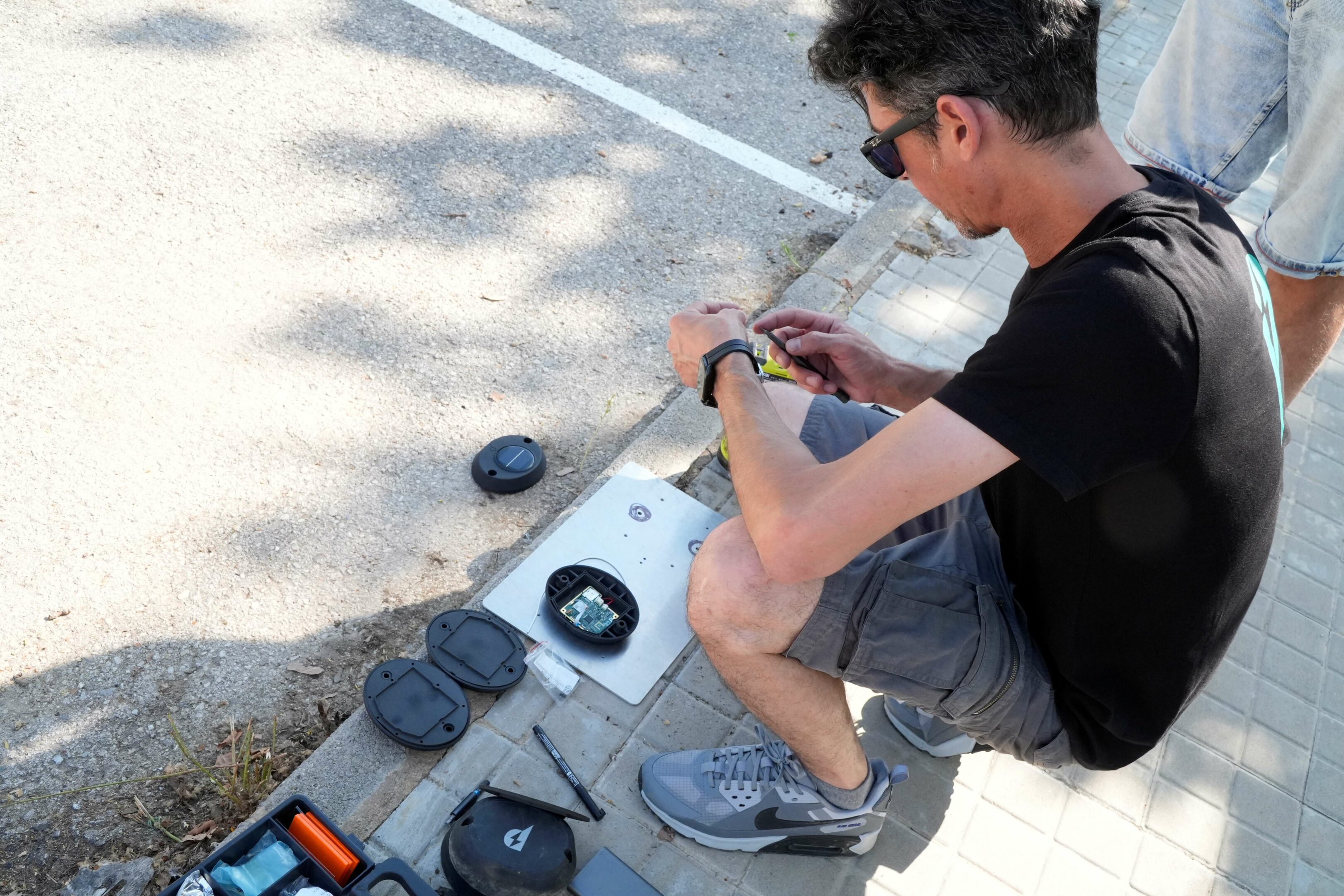
As part of the project, seven smart devices have been installed. Five of them monitor the real-time availability of parking spaces in the outdoor car park. The remaining two incorporate a Bluetooth-based verification system to ensure that designated reserved spaces are used only by authorised vehicles, without collecting any personal data from users.
The sensors operate autonomously thanks to an integrated battery and transmit data via Narrowband IoT (NB-IoT) technology. Installation is quick and requires no civil engineering works, as only two drill holes are needed to secure each device to the pavement. In addition, the units are fitted with solar panels that significantly extend their operational lifespan by recharging the batteries, providing a clear competitive advantage.
Through the control panel developed by Flash Park, Conference Centre staff will be able to monitor the status of each parking space in real time and verify the occupancy of reserved bays. The company will also provide regular reports on parking occupancy and turnover, generating valuable data to assess parking patterns and explore the potential application of the solution in other urban environments.
Llobet concluded: “Through initiatives such as this, the City Council continues to strengthen the Urban Sandbox as a tool for accelerating innovation, fostering collaboration between the public sector and businesses, and validating technologies that help address urban challenges through sustainable, data-driven solutions.”