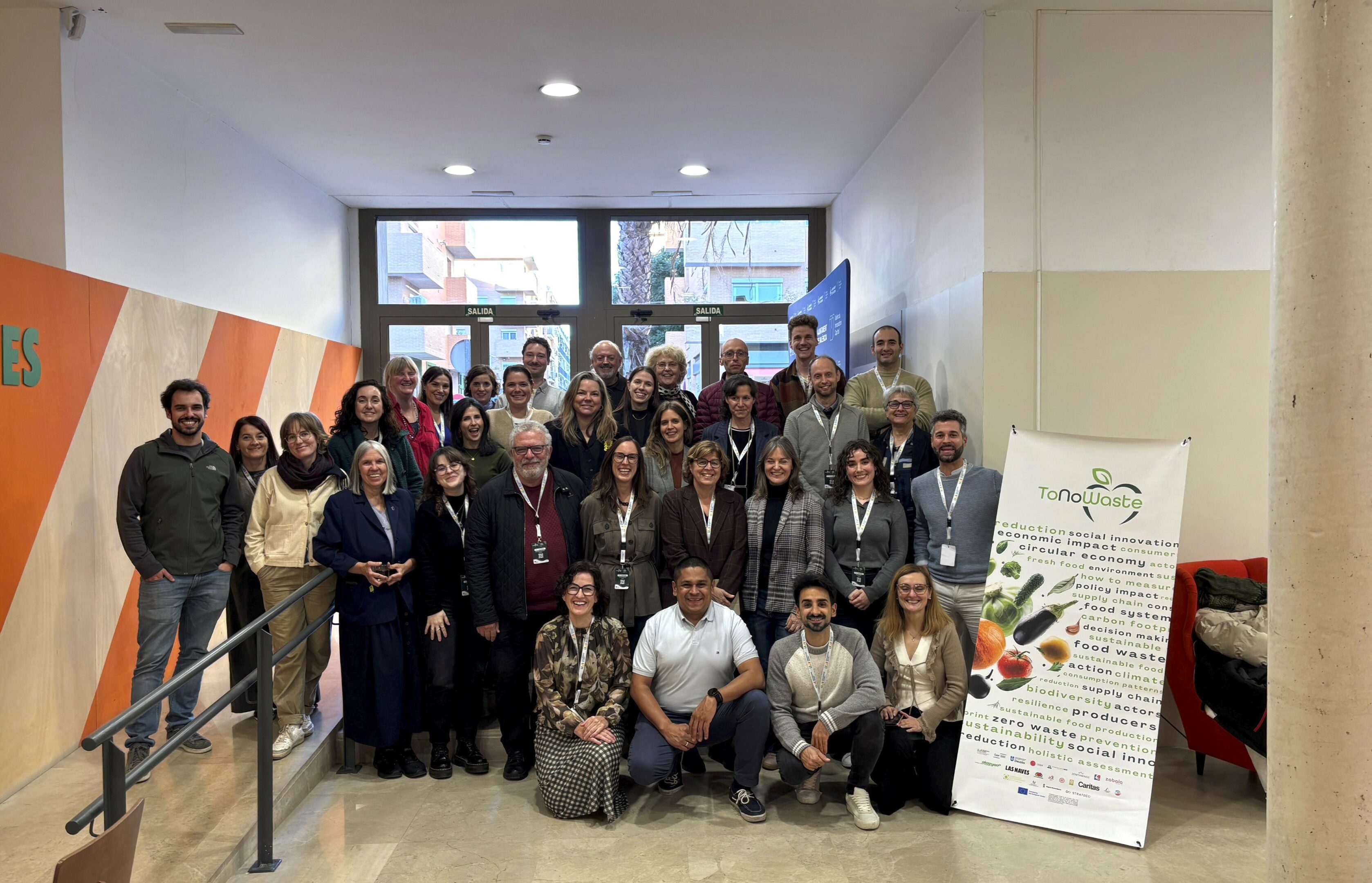
- The European project brings together in Valencia representatives from 21 institutions in seven countries that have been working to prevent and reduce food waste.
- Valencia has become a testing ground for evaluating solutions in real-world contexts, ranging from food production and distribution to school cafeterias, tech startups, and households.
- The project’s results provide new tools, data, and insights to translate research into concrete solutions and public policies to address food waste.
After four years of developing and testing new solutions, the European ToNoWaste project concludes its journey with a final event in Valencia. The event, held from November 25 to 27, brought together representatives from 21 institutions across seven countries to share the project’s key findings, tools, and lessons learned and to move toward new ways of preventing and reducing food waste.
ToNoWaste has combined research, innovation, and experimentation to address a common challenge: how to measure the sustainability of initiatives aimed at preventing or reducing food waste. After four years of work, the project is now focused on turning the evidence gathered into tools and solutions that help companies, government agencies, and other stakeholders in the agri-food chain make better decisions.
Valencia has played a key role as a testing ground for the project, applying the research to real-world contexts and connecting production, distribution, school cafeterias, technology entrepreneurship, government, and citizens.
In the words of Paula Llobet, Councilwoman for Innovation, Tourism, and Investment Attraction for the City of Valencia,“These past four years of ToNoWaste have shown that innovation can help us tackle food waste at different points in the supply chain. In Valencia, we have brought together research, technology, businesses, entrepreneurship, government, and citizens to apply this knowledge to real-world situations and test new ways to prevent and reduce food loss and waste.”
“Although the project is coming to an end, the challenge continues. We now have the opportunity to ensure that the knowledge, tools, and partnerships developed over the past four years continue to translate into better decisions and new solutions that will allow us to move toward a more sustainable food system,” added Paula Llobet.
Valencia: From Research to Real Solutions
ToNoWaste has put its research into practice through two pilot projects carried out in Valencia and in Vienna and Graz, Austria. In Valencia, the pilot project was coordinated by Valencia Innovation Capital, which worked alongside Cooperatives Agroalimentarias de la Comunitat Valenciana (CACV), Mercavalencia, and CUINATUR to identify where food losses occur and test solutions to prevent them. The Universitat Jaume I (UJI) is responsible for the overall coordination of the project.
One of the main initiatives has been Agro·lab ToNoWaste, the acceleration program launched by València Innovation Capital to promote the development of innovative and technological solutions to food waste. Over the course of its two editions, ten startups have developed and tested proposals applicable to different areas of the supply chain.
The solutions developed by these startups have addressed a wide range of challenges: from using artificial intelligence to improve harvest planning to technologies for extending food shelf life, packaging made from recyclable natural fibers, tools for measuring food waste in professional and school kitchens, and platforms for managing surplus food and donations.
This initiative has also reached the general public. A total of 152 people have participated in citizen engagement campaigns to analyze behaviors, barriers, and possible solutions related to food waste. Among them were college and vocational school students, professionals in the hospitality industry, and social organizations, who addressed issues such as the donation of surplus food and compliance with Law 1/2025.
ToNoWaste has also turned this challenge into an everyday practice: how we store food at home. Two participatory urban marketing initiatives challenged the public to store various products properly in order to extend their shelf life and prevent waste. The initiative, in which more than 50 people participated at the Central Market in Valencia and on the UPV university campus, has resulted in a toolkit that includes the methodology and materials needed to replicate the activity in other contexts and share best practices with the public for better food preservation and reducing food waste at home.
From Knowledge to Decision-Making
The final sessions held in Valencia provided an opportunity to share this journey from research to practical application.
In addition to internal working sessions among ToNoWaste partners, the program has created three forums for sharing the project’s results and lessons learned with various stakeholders and advancing its implementation beyond ToNoWaste: a workshop on the measurement platform, a local and regional meeting on food loss and waste (FLW), and an international conference focused on translating these findings into public policy.
Representatives from ANECOOP, the Valencian Regional Government, Mercavalencia, Cuinatur, Eroski, and AVACU, among other stakeholders, have offered different perspectives on a challenge that affects the entire food chain: from those who produce and distribute food to those who sell, prepare, or consume it.
The conclusion of the ToNoWaste project has drawn attention specifically to how to ensure the continuity of the knowledge generated by the project. The international conference “From ToNoWaste forward: How to create policies to prevent and reduce food loss and waste?”, held on November 27, brought together public officials, experts, and representatives from other European projects to discuss how to translate the evidence and lessons learned into public policies capable of bringing about long-term change.
Legislation, social norms, and the functioning of markets have been part of a debate aimed at translating research findings into decision-making and moving from waste management toward waste prevention, creating conditions that prevent waste from occurring in the first place.
ToNoWaste thus concludes four years of work by opening new avenues for continued progress in the prevention and reduction of food waste: data to improve decision-making, solutions tested in real-world contexts, and new partnerships among the various stakeholders in the agri-food chain. The project is coming to an end, but the challenge remains: to transform the knowledge generated into new solutions and policies that contribute to a more sustainable, efficient, and less wasteful food system.