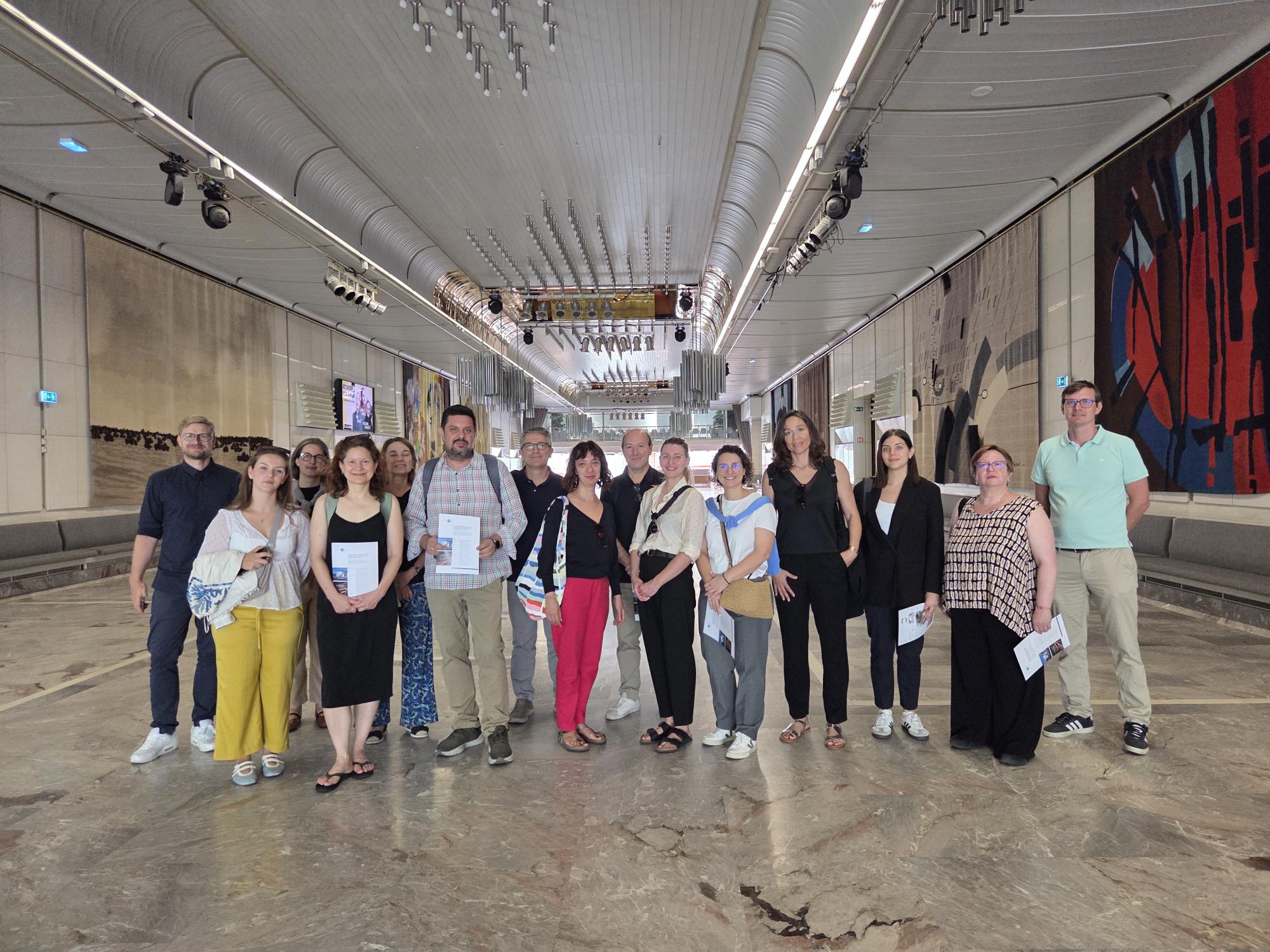
- Partners in the European Zentropy MICE project are meeting in Heidelberg (Germany) and Ljubljana (Slovenia) to explore the transfer of the sustainable meetings tourism model developed by the City Council of Valencia.
- The project is progressing in the validation of innovative solutions such as urban entropy management and the legacy programme, aimed at transforming the impact of MICE events into tangible benefits for cities.
- Valencia is strengthening its position as a European benchmark by leading the transition towards a MICE tourism model that creates lasting value for the city through legacy.
Partners in the European Zentropy MICE project are taking part this week in a study visit to Heidelberg (Germany) and Ljubljana (Slovenia) to explore opportunities for transferring the model developed in Valencia to these European municipalities. Larissa (Greece) also participates in the project as a transfer city.
Organised in two stages—from 6 to 8 July in Heidelberg and from 8 to 10 July in Ljubljana—the study visit brings together institutional representatives and technical experts from both the project partners and the transfer cities. The intensive programme combines technical sessions, co-creation workshops and visits to key MICE and urban sustainability infrastructures to identify opportunities for replicating the Zentropy MICE model in these municipalities.
In this context, Paula Llobet, Councillor for Tourism, Innovation and Investment Attraction at the City Council of Valencia, highlighted that Zentropy MICE is “a pioneering European initiative that strengthens Valencia’s position as a benchmark for sustainable meetings tourism through its disruptive and innovative approach to transforming business events into drivers of social, economic and environmental change.”
According to Paula Llobet, “Zentropy MICE demonstrates that Valencia is ready to lead the tourism of the future: smart, sustainable tourism that creates value, contributes to the common good and supports the future of our city.” She also noted that, through this model, “every conference held in Valencia can help share knowledge, create jobs, and build a lasting legacy and civic pride.”
An innovative model to transform meetings tourism
The study visit marks an important step in establishing Zentropy MICE as an innovative model that redefines the role of meetings tourism in cities by integrating it into urban strategies and transforming the impacts of events into measurable benefits for citizens.
The project applies the concept of urban entropy to the MICE sector, making it possible to optimise the flows of energy, materials and information generated by events, reducing negative impacts while creating long-term value through knowledge, innovation, citizens’ wellbeing and social cohesion.
To achieve this, Zentropy MICE is developing its own methodology, including a dedicated measurement tool—the Urban Entropy Calculator, designed by the Universitat Politècnica de València—and the implementation of strategic programmes aimed at maximising the positive impact of conferences on the urban environment.
Legacy at the heart of knowledge transfer
One of the main focuses of the study visit is the analysis of the legacy programme currently being co-designed by the City Council of Valencia together with the project partners. The programme seeks to connect the knowledge generated through conferences with the city’s innovation ecosystem and its key stakeholders, amplifying its value and creating an impact that extends well beyond the events themselves.
During the working sessions, municipal teams and technical partners are identifying opportunities to generate legacy in areas such as social impact, economic innovation and knowledge transfer, while designing programmes tailored to the specific needs of each city.
Co-creation workshops are also being held to explore how these initiatives can be replicated and integrated into local urban strategies, in line with the project’s participatory and results-oriented approach.
A European process of learning and exchange
The study visit programme includes presentations on sustainable tourism policies, analyses of conference infrastructure and local case studies, as well as technical sessions focused on the Zentropy MICE model, its innovation framework and the tools developed throughout the project.
In Heidelberg, discussions focus on sustainable urban planning and the integration of tourism into the local economy, while in Ljubljana attention is given to sustainability indicators, tourism governance models and innovative conference venues.
These activities will support the definition of pilot actions to be tested in the transfer cities, reinforcing the project’s experimental and replicable approach.
A model that can be replicated across Europe
Zentropy MICE is positioning itself as a scalable and transferable model that addresses today’s urban challenges by aligning meetings tourism with the strategic priorities of European cities.
Through this transfer process, València further strengthens its role as a leading city in urban innovation and sustainable tourism, driving a new generation of public policies that position business events as engines of transformation, innovation and long-term legacy.
About Zentropy MICE
Zentropy MICE is a European project co-funded by the European Union under the European Urban Initiative (EUI). It is led by the City Council of Valencia, in collaboration with València Innovation Capital, the Visit València Foundation, the València Conference Centre, the Universitat Politècnica de València, and the consultancy Khora Urban Thinkers, together with the transfer partner cities of Heidelberg (Germany), Ljubljana (Slovenia) and Larissa (Greece).
Running until May 2028 with a total budget of €5.2 million, 80% co-funded by the European Regional Development Fund (ERDF), Zentropy MICE is positioned as a flagship initiative to promote a more sustainable, innovative and resilient model of meetings tourism, aligned with the urban challenges facing European cities today.